call for papers
tei'27: the body in space
TEI’27 is the 21st annual conference dedicated to tangible, embedded, and embodied interaction. The ACM TEI conference brings together researchers, practitioners, artists, designers, and students from a variety of disciplines, including interaction design, computer science, engineering, product design, media studies, and the arts. The intimate size of this single-track conference provides an engaging forum for exchanging ideas and presenting innovative work through talks, demonstrations, posters, art installations, performances, hands-on studios, and scholarly workshops.
The theme for TEI'27, "The Body in Space", foregrounds how bodies – individual and collective, human and non-human – inhabit, move through, sense, and shape physical and hybrid spaces.
We invite works that examine corporeality and spatiality in interaction design, for example:
- Embodied sensing and actuation
- Spatial interfaces and locative experiences
- Movement, gesture, and kinaesthetic interaction in public and private spaces
- Tactile, haptic, and multisensory design that links bodies and environments
- Choreography of social and collaborative interactions across shared spaces
We invite paper submissions from a wide range of perspectives: technical, applied, empirical, theoretical, philosophical, conceptual, and artistic. We welcome contributions from fields including but not limited to: tangible interaction design, embodied interaction design, embedded computing, digital fabrication, hybrid craft, e-textiles, wearables, haptics, robotics, smart cities, smart materials, (post-) industrial design, and sustainability.
We expect submissions to be clearly framed within the rapidly developing tangible, embedded, and embodied interaction field. Works framed as research through design and more technical contributions are particularly welcome. We also encourage the submission of works that explore the opportunities and the pitfalls of AI in the field of tangible, embedded, and embodied interactions, from their design, to their implementation and use.
important dates
| Submission Deadline | August 6, 2026 (AoE) |
| Notification of (Conditional) Acceptance | October 22, 2026 |
| Updated Submission on PCS (Non-Anonymized) | November 3, 2026 |
| Notification of Acceptance for Conditionally-Accepted Submissions | November 13, 2026 |
| Publication-Ready Deadline on TAPS | November 19, 2026 |
| TEI 2027 Conference | January 24-27, 2027 |
contribution types
Authors are invited to submit high-quality papers that contribute to advancing this rapidly developing field. We highlight the following non-exclusive set of contribution types:
- Artifact: Research artifacts that advance the state of the art in tangible, embedded and embodied interaction. Artifacts can demonstrate new technologies (e.g., new sensing techniques or algorithms), new forms of input (e.g., novel interaction techniques), or new designs (e.g., provocative or evocative objects, systems, or services).
- Method: Tools, approaches, and techniques that enable researchers, technologists, designers, and practitioners to conduct research and practice in the field of tangible, embedded, and embodied interaction. Methods can include new forms of study design or data analysis, as well as new engineering processes or frameworks.
- Theory: Explorations, extensions, refutations, instantiations, and other developments of the theories pertaining to tangible, embedded, and embodied interaction, such as theories of cognition or the mind, as well as design theories, and conceptual frameworks.
- Empirical: Studies and data that add to our understanding of tangible, embedded, and embodied interaction by, for example, providing quantitative accounts of salient aspects of human performance, or qualitative characterizations of experiences with tangible artifacts and systems. Empirical submissions can detail outcomes from a wide range of lab, field, and online studies.
Respecting the diversity of approaches and methods that together make up TEI, each contribution type will be peer-reviewed on its own merits. We seek high-quality work regardless of the specific subdomain or topic, and we expect the work to be positioned firmly in, and building on, prior research in our field.
Accepted submissions of all contribution types will be included as papers in the conference proceedings, which will be available in the ACM Digital Library.
ethical research statement
The TEI community follows the ACM ethical research guidelines and adheres to the ACM policy of involving human participants. Authors are encouraged to include details in the methods section on participants' recruitment, selection, and consent. Deviations or novel considerations should be discussed, when different from typical practice. Some examples include:
- If the study involved human participants, a clear statement indicating this.
- Details on how participants were recruited and selected.
- An explanation of the consent process (e.g., whether participants provided informed consent, what information was shared with them, and how consent was documented).
- A description of how participants were treated during the research.
- Information on data handling and sharing, including how privacy and confidentiality were addressed.
- Any additional ethical considerations relevant to participant involvement.
- Information on ethical approval, including the name of the institutional review board or ethics committee, if applicable.
For details, please consult the ACM guidelines below:
ACM Code of Ethics and Professional Conduct: https://www.acm.org/code-of-ethics
ACM Publications Policy on Research Involving Human Participants and Subjects: https://www.acm.org/publications/policies/research-involving-human-participants-and-subjects
preparing your submission
Paper length. Authors should submit a paper with a length proportional to its contribution. While there is no maximum or minimum length for papers, the length of typical submissions is expected to be approximately 7,000–8,000 words excluding references, figure/table captions, and appendices. Reviewers will be instructed to weigh the contribution of a submission relative to its method and length. Papers should be succinct but thorough in presenting the work. Shorter, more focused papers are encouraged and will be reviewed like any other paper. Papers whose lengths are incommensurate with their contributions will be rejected.
ACM format requirements. TEI'27 uses the new ACM workflow TAPS for submission templates and published papers. TAPS requires the use of a simplified one-column template for submission, while the final two-column paper will be rendered for publication after acceptance. We strongly recommend using the LaTeX templates rather than Word. All relevant information, including submission templates in Word and LaTeX, can be found here: https://www.acm.org/publications/authors/submissions
Authorship policy. Your submission must be original. TEI only accepts original submissions. This means that your submission cannot have been published in another peer-reviewed venue, or be under concurrent review at another peer-reviewed venue. Similarly, if you make multiple submissions to TEI’27 Papers, their contributions must be self-contained, and distinct from each other. Please refer to the ACM policy on authorship for details. Authors should avoid using text generated by AI-tools (e.g., LLMs such as ChatGPT or similar). The use of AI-tools must be disclosed in the acknowledgements section of your submission.
Anonymization policy. All papers must be anonymized for review. Author and affiliation sections and credits must be left blank. Authors of accepted submissions will add this information in preparation of the updated (PCS) and publication-ready versions (TAPS). We are using the ACM IMWUT Anonymization Policy. We use a relaxed model that does not attempt to conceal all traces of identity from the body of the paper.
Authors are expected to remove author and institutional identities from the title and header areas of the paper. Make sure that no description that can easily reveal authors' names and/or affiliations is included in the submission (e.g., overly detailed descriptions of where user studies were conducted). Also, please make sure that identifying information does not appear in the document's metadata (e.g., the 'Authors' field in your word processor's 'Save As' dialog box). In addition, we require that the acknowledgements section be left blank, as it could also easily identify the authors and/or their institution.
Further suppression of identity in the body of the paper is left to the authors' discretion. We do expect that authors leave citations to their previous work unanonymized so that reviewers can ensure that all previous research has been taken into account by the authors. However, authors are encouraged, but not required, to cite their own work in the third person, e.g., avoid "As described in our previous work [10], … " and instead use "As described by Jones et al. [10], …".
Submission. All abstracts, full papers, and supporting materials (including an optional 3-minute video) must be submitted electronically via the Precision Conference (PCS) website by the submission deadline (see above for all relevant dates). At the time of submission, authors must select their preferred presentation format. If authors choose to present their work as an artifact (demonstration), authors will be asked to provide the basic requirements of their demo.
Regardless of length and contribution type, a paper may be scheduled as a talk, demo, and/or poster. Please reflect on what you find the most appropriate presentation format for your work. All submissions accepted in the paper track are published as archival full papers, irrespective of the chosen presentation format.
Policy on use of generative AI / large language models. Text and images generated from AI services, such as ChatGPT, must be clearly marked where such tools are used for purposes beyond editing the author's own text. Please carefully review the April 2023 ACM Policy on Authorship before you use these tools. ACM has an FAQ page responding to specific questions on how to acknowledge the use of such tools, and we refer to it for guidance. While we do not anticipate using tools on a large scale to detect LLM-generated text, we will investigate submissions brought to our attention and desk-reject papers where LLM use is not clearly marked.
review process
Process at a glance
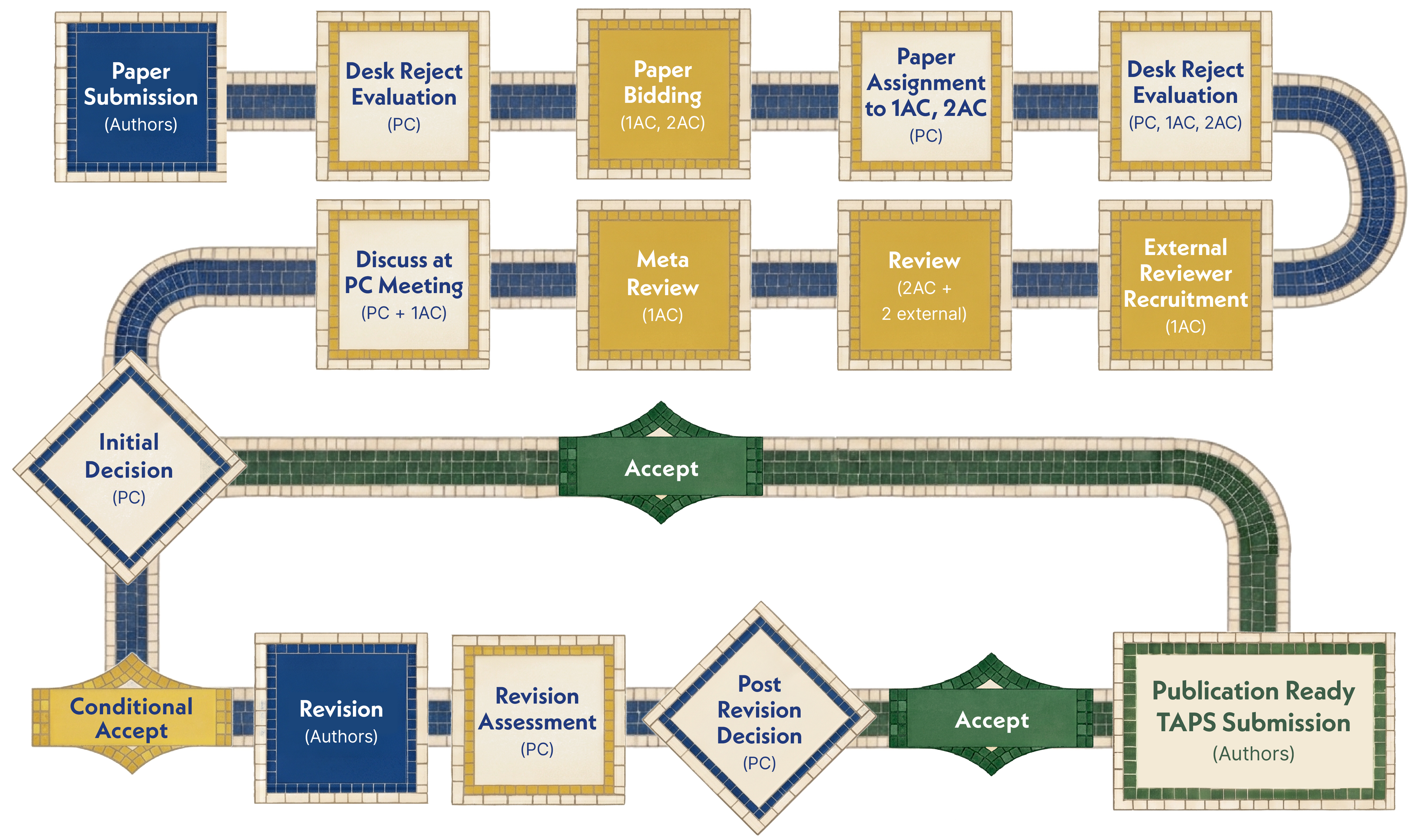
From paper submission to initial decision. The paper review process for TEI'27 will include the following stages:
- Desk rejection evaluation: the Papers chairs, in collaboration with 1ACs and 2ACs can make desk rejection decisions before papers are sent out for full reviews. Papers with a length that is not proportional to their contribution, papers that are not positioned firmly in prior research in our field, not properly anonymized, not formatted according to the recommended template, or that are out of the scope of the conference, will be considered for desk rejection.
- ACs will bid to review papers. After the paper-bidding process, the Papers chairs will assign each paper to a primary AC (1AC) and a secondary AC (2AC), taking into account AC expertise in the topic area of each submission.
- The 1AC will recruit two external reviewers. Each external reviewer and the 2AC will write a detailed review of their assigned submissions and assess the contribution of the research to the field. Thus, each paper will receive 3 detailed reviews.
- Once the reviews are written, the 1AC is responsible for the quality of the reviews and will write a meta review of the paper, summarising the reviews from the two external reviewers and the 2AC. If 1ACs disagree with the other reviews, they are encouraged to write a separate review in addition to the meta-review.
- The 1AC will present a recommendation for the paper's acceptance or rejection to the Papers Chairs. The Papers chairs will decide on the acceptance of all papers for inclusion in the program in a discussion phase (initial decision), based on the 1AC recommendation, the reviews, and fit to the conference. The Papers chairs will make one of three decisions for each paper: accept (no changes are necessary), conditional accept (mandatory changes before the paper is accepted), or reject.
After (conditional) acceptance. Conditional acceptance will include requirements to make modifications to the paper. The required modifications will be clearly identified in the notification of conditional acceptance.
Authors will submit updated papers in PCS. All changes must be highlighted in the updated file submitted in PCS and authors must provide a change log to assist the 1ACs in reviewing their changes. This submission should already be non-anonymized and use the two-column layout required for publication. 1ACs will assess if the mandatory changes were implemented, as requested in the conditional acceptance notification. If, in their assessment, the changes were implemented, they will accept the paper. Otherwise they will reject it.
Authors who have accepted papers (either immediately after the first notification or after their revised paper was accepted), have to submit the publication-ready version through TAPS.
One author of each accepted paper is required to register for TEI’27. Accepted papers will be included in the Proceedings of TEI’27, and will become available in the ACM Digital Library and be distributed digitally to conference delegates as part of the conference proceedings.
At the conference, authors of accepted submissions must present their work and be available to answer questions from other conference participants. Presenters of papers will have a presentation slot at the conference. Information on presentations will be sent by email to the corresponding author. Papers whose authors do not present in any form (talk, demo, and/or poster) may be removed from the ACM Digital Library and the conference proceedings.
Accepted authors should ensure they have obtained permissions to use licensed content and images that depict identifiable people in their conference contributions (papers/pictorial, videos, and presentations). Authors will also be required to give permission to include their contributions in the ACM Digital Library. Authors can either assign copyright or a license to the ACM or they can pay a fee to ACM for open access. More information on rights management can be found here: https://authors.acm.org/. Finally, and as part of this rights management process, presenting authors will be asked to opt in, and grant permission, to record and/or stream their presentations at the conference.
Confidentiality. Confidentiality of submissions will be maintained during the review process. All rejected submissions will be kept confidential in perpetuity. All submitted materials for accepted submissions will be kept confidential until publication.
taps workflow
For details on the TAPS publication workflow please read the following page: https://authors.acm.org/proceedings/production-information/taps-production-workflow
acm publication policies
By submitting your article to an ACM Publication, you are hereby acknowledging that you and your co-authors are subject to all ACM Publications Policies. Alleged violations of this policy or any ACM Publications Policy will be investigated by ACM and may result in a full retraction of your paper, in addition to other potential penalties, as per ACM Publications Policy.
Please ensure that you and your co-authors obtain an ORCID ID, so you can complete the publishing process for your accepted paper. ACM has been involved in ORCID from the start and has made a commitment to collect ORCID IDs from all published authors: https://authors.acm.org/author-resources/orcid-faqs. ACM is committed to improving author discoverability, ensuring proper attribution and contributing to ongoing community efforts around name normalization; your ORCID ID will help in these efforts.
open access
All ACM publications, including those from ACM-sponsored conferences, are 100% Open Access. Authors have two primary options for publishing Open Access articles with ACM: the ACM Open institutional model or by paying Article Processing Charges (APCs). With ~3,000 institutions already part of ACM Open, the majority of ACM-sponsored conference papers will not require APCs from authors or conferences (currently, around 76%.
Authors from institutions not participating in ACM Open will need to pay an APC to publish their papers, unless they qualify for a financial or discretionary waiver. To find out whether an APC applies to your article, please consult the list of participating institutions in ACM Open and review the APC Waivers and Discounts Policy. Please keep in mind that waivers are rare and are granted based on specific criteria set by ACM.
To support authors and institutions as they continue to adapt to ACM’s Open Access publishing model, the ACM Council has approved subsidized APC rates for calendar year 2027 allowing more time for institutions to join ACM Open. The subsidy will offer:
- $500 APC for ACM/SIG members
- $750 for non-members
This represents a 29% discount off current APC list pricing, funded directly by ACM. Authors are encouraged to help advocate for their institutions to join ACM Open during this transition period.
program committee
Marwa AlAlawi, MIT CSAIL
Abul Al Arabi, Texas A&M University
Nivedita Arora, Northwestern University
Heidi Biggs, Georgia Institute of Technology
Francesco Cafaro, Indiana University Indianapolis
Jorge Cardoso, University of Coimbra
Tingyu Cheng, University of Notre Dame
Hyungjun Cho, University of Florida
Barbara Corsetti, Universidad Carlos III de Madrid
Himani Deshpande, Aarhus University
Dina EL-Zanfaly, Carnegie Mellon University
Verena Fuchsberger, University of Salzburg
Lucca Geurts, KU Leuven
Ariel Han, Utah State University
MacKenzie Harnett, Texas A&M University
Linda Hirsch, University of California Santa Cruz
Eva Hornecker, Bauhaus-Universität Weimar
Ayaka Ishii, Meiji University
Lee Jones, Carleton University
Mohammad Ridwan Kabir, Queen's University
Yasuaki Kakehi, The University of Tokyo
Pouya M Khorsandi, Queen's University
Hyunyoung Kim, University of Birmingham
Marion Koelle, Hochschule RheinMain - University of Applied Sciences and Arts
Sabrina Lakhdhir, University of Victoria
Chang Hee Lee, KAIST
Jiaji Li, MIT CSAIL
Rong-Hao Liang, Eindhoven University of Technology
Akshay Madhav Deshmukh, TU Bergakademie Freiberg
Bernardo Marques, University of Aveiro
Martin Murer, University of Salzburg
Ken Nakagaki, University of Chicago
Ian Oakley, KAIST
Netta Ofer, University of Colorado Boulder
Patricia Oliveira, University of Aveiro
Nathalie Overdevest, Monash University
Sofia Ribeiro, University of Aveiro
Michal Rinott, Shenkar
Aryan Saini, Monash University
Dorothé Smit, Vrije Universiteit
Dishita Turakhia, Emory University
Brygg Ullmer, Clemson University
Jelle van Dijk, University of Twente
Rosa van Koningsbruggen, Bauhaus-Universität Weimar
Yixiao Wang, Georgia Institute of Technology
Alexander Wiethoff, LMU Munich
Stefanie Wuschitz, Academy of Fine Arts Vienna
Hironori Yoshida, Aalto University
Yuchong Zhang KTH, Royal Institute of Technology
papers chairs
Hwajung Hong, KAIST
Andrew L. Kun, University of New Hampshire
Ylva Fernaeus, Umea Institute of Design and KTH
For further questions, please contact the Papers chairs at papers_27@tei.acm.org